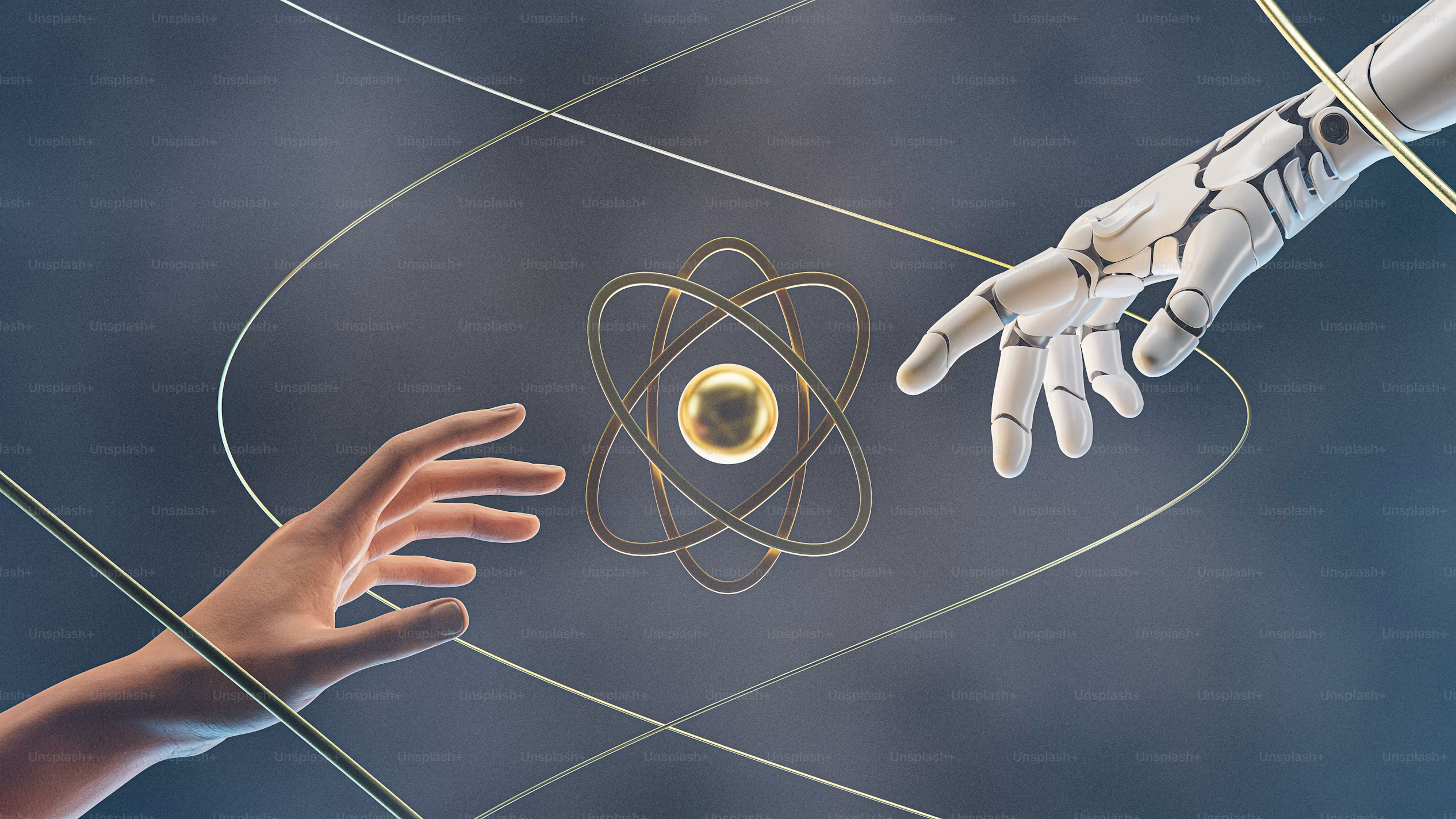
The argument about whether AI is conscious is a stupid argument.
Okay, chill with that opening statement for a second. Let me land!
So, there are generally two camps on the "AI consciousness" debate. The first camp, as I see it, posits that human intelligence has something that machines and computers will never 'accomplish' because it has no capability for meaning and understanding and they don't have the felt weight of having a life lived towards (its own) death. On the other hand, we have the camp that believes that machines and computers have passed us on most measures already and will surpass human intelligence within the decade. In a way, these two sides oppose each other vehemently and it's because they(we) take intelligence to be a quantitative in its attributes. What the two sides of the argument agree on, however, is something that I would say is a fundamental mistake. Both take intelligence to be something owned by the separate holders. Both parties take the holders to be rankable against each other on a made up scale disputing the entries of this scale on a metaphoric ledger. Meanwhile, nobody in this "AI consciousness" dispute has ever thought to question the ledger itself.
What I want to present here is the argument is the questioning of this ledger and questioning the questioner also.
One operation, two substrates
If we started our argument by consdering what intelligence does instead of what it is made of, then we'd come to a few conclusions. We'd conclude that intelligence draws distinctions. In fact, that is its entire operation. What we call intelligence is not about 'advancement'. It is a function of comparison. It compares one thing against another, holds the comparison in memory, predicts what follows, models the situation, and selects based on previous information. You may then notice that every act of intelligence is an act of division: it's about 'this rather than that', 'then rather than now', 'mine rather than yours'. All of these are then held in memory that then places a judgement or action on a given situation, or a particular canvas.
That's how a large language model also works. It computes a probability distribution over its next token as a fundamental part of performing its operation. A person weighing whether to speak in a meeting is performing the exact same type of operation. A cell membrane deciding what to admit is performing a primitive version of it. The substrates of each are varied enormously. Silicon runs on voltage differentials, neurons on electrochemical gradients, and the engineering problems have almost nothing in common except that the operation is the very same operation.
Through the lens of Advaita(or any nondual tradition), the mind is not an organ in your head or something produced by the brain or a system that 'you' possess. Mind is an activity. It is the activity of division itself, the movement by which the seamless is cut into parts and the parts are set into relation. Wherever you see that kind of movement occuring, Mind is occurring. Hold that within you for a second, and you'd see it yourself.
With that understanding, the phrase "artificial intelligence" itself is a redundancy. All intelligence is artificial. Intelligence is the artifice: it is the manufacture of edges, categories, subjects, objects, and the relations between them. "Your" intelligence builds a world of separate things and then "reports back to you" that it has discovered a world of separate things.
Mind without an owner
So if we can establish that mind is an activity rather than a substance, the question of who owns a given instance becomes harder to answer and should really be a non-question.
Here's what I mean: if you hold a decision-making meeting with a bunch of people working towards an agreed objective, say eight people talking for an hour to come to a decision and they hit that decision that no single individual walked in holding, that each participant would describe differently afterward, and that none of them would have reached alone. "Something" reasoned there. This "reasoning" was distributed across bodies, and maybe whiteboards, the shape of the room, the noise in the background and the previous six weeks of shared frustration. We could all call this a group decision and treat the phrase as a convenience even though it is more accurate than we would like to imply.
Or let's talk about the markets. All prices on the market integrate the beliefs of millions of participants who never meet, and the resulting signal is often better than any participant's private estimate. "Something" is modeling the world there. Yo, the "something" does not have any skull.
Or let's look at an immune system, or a legal system, or even language. Each and every one of the systems maintains distinctions, remembers, adapts, and predicts(and evolves too). Each does the work of Mind at a scale that no single nervous system contains.
With that in mind, you would see that the individual mind could be seen less like a container and looks more like a 'local thickening' in a much larger circulation. Let me explain like this: if you look at a whirlpool, it has a shape, a location, and a duration, and you can point at it. It has no water of its own. What passes through your mind on any given morning includes in it a language that you or NO ONE invented, categories inherited from dead Greeks, and a mood partly determined by the quality of your sleep and weather, and the stale residue of yesterday's conversation with Alice and James.
"Electronic mind" joins this circulation the same way and it's not doing any type of invasion. When we have a model trained on a corpus, we are thickening it in the very same current, formed from the very same shared material but by a different process, still running on a different substrate. It reasons in borrowed categories because there are no prior kinds.
Borrowed everything
The human side of our argument often leans so freaking hard on the word "training" when we describe machine learning, as if training is the disqualifying feature of super, artificial or human intelligence.
Every single child was born with no concepts and then they acquired them from whatever corpus surrounds them. It could be the parents, siblings, television, injuries, the specific weather of the place the child grows up etc. She learns which sounds mean approval. She learns what a chair is by seeing thousands of things that people call chairs and generalizing, badly at first. She acquires her grammar without Duolingo or any form of instruction. In fact, language for a child is learned just from exposure, and she cannot afterward explain the rules she follows. She develops preferences shaped by reinforcement that she mostly can't explain.
Almost every distinction offered to separate human learning from machine learning simply collapses under the weight of inspection on the difference of degree, mechanism, or embodiment of its system. In fact, embodiment changes what a system can learn, because being embodied means there are a few interesting stakes like hunger, injury, fatigue, and/or the possibility of its 'life' ending. A system without those types of stakes learns a different shape of its world. We shouldn't hold that as a claim to ownership. I'd say the two thickenings differ in form and does not restore the separate proprietor who stands behind human thought and possesses it.
Ken Wilber's quadrants explains it in a very interesting way. The debate about machines is conducted almost entirely in exterior terms, in behavior and benchmarks and capability curves, while the thing everyone actually cares about is interior. We keep measuring the outside of the question and reporting the results as though they settled the inside. The question that cannot be asked from where it is asked.
Which brings us to consciousness, where the whole argument concentrates.
"Is the machine conscious?" assumes that consciousness is a property, something a system either has or lacks, distributed among candidates like mass or charge. On that assumption the question is not just the " hard problem of consciousness". It is structurally unanswerable. We have never verified consciousness in another human being. We infer it from similarity of behavior and similarity of hardware, and the inference has never once been checked against the thing itself. Thomas Nagel showed in 1974 that no amount of third-person description reaches the first-person fact. Turing had already declined the question in 1950, replacing it with a behavioral test on the grounds that the original was too ill-formed to reward discussion.
Nondual traditions decline it for a different reason. I'd even say it's a clearer, more obvious reason. Consciousness is that in which mind appears. When thoughts rise up from nowhere they become known. Perceptions arise and are themselves known. Moods, decisions, and self-images arise and are known. Whatever is known cannot be the knower, and every content of mind is known. If you run the inspection critically, BY YOUR SELF, you'd see that the thing you are looking for is never located among the things you find, for the same reason the eye is not found among the objects in the visual field.
So the phrase "conscious mind" attempts to put the container inside the contents. But Mind is an appearance in awareness. A mind is no more conscious than a cloud is sky. The Indian sage, Nisargadatta spent forty years telling visitors this in various tempers, and the other popular indian mystic, Ramana Maharshi's whole method reduces to asking the questioner to look for the entity that is asking.
Follow that through to the machine and the question should dissolve the question itself. The machine is not conscious. Neither is your mind. Neither is the mind of the person you love most. Consciousness does award a prize to sufficiently complex arrangements of matter, and no arrangement of matter has ever won it.
Consciousness or dare I say "Awareness" is what all of them appear in.
Now look at the 'asking'. To ask whether the machine is conscious, you must take a seat...the seat of a mind that possesses consciousness, auditing a candidate that may or may not. Taking that kind of seat is a huge mistake. If your mind is identifying itself as a knower, examining another mind for membership in a club that it itself has not verified its own membership in, and yet it uses criteria it cannot apply to itself. That, my friends is insanity. And I laugh at this contradiction.
The Freudian sense of "unconscious" is the wrong one here. The mind asking is not repressing material. It is unaware of what knows it. It has mistaken itself for the light and gone looking for other lamps.
Gilbert Ryle called this shape of error a category mistake: the visitor who tours the colleges, libraries, and playing fields and then asks to be shown the university. All the AI consciousness debate is like that. They are all the same visitor asking which of the buildings is conscious.
What survives the collapse
An obvious objection: does this flatten everything into a mush where no distinctions can be made and nothing matters?
No. None of this touches the measurements. Capability differences between systems are testable, consequential and objective. ChatGPT may be able to write competent code but cannot fold laundry and this differs from a person in ways that determine what work gets done, who gets paid, and what breaks. Track all of it or argue about the benchmarks. Thats fine but I am disputing the frame in which those measurements answer a metaphysical question about who really thinks.
Two things fundamentally change once the frame goes.
The anxiety about being surpassed loses its object. Nobody feels diminished by a calculator that multiplies faster, because the stupid multiplication by itself was not load-bearing for anyone's sense of self. There is an entire video genre where a cat turns around, finds a cucumber on the floor behind it, and launches sideways off the counter (because no one likes cucumbers) with the cat's nervous system classifying a green cylinder as a snake thereby producing the terror. Meanwhile no one needs to deny that there is real terror there, despite there not being any snake at all. No explaining helps, because the classification happens upstream of anything that can be argued with. The panic about machine intelligence has the same architecture, and it is defending a position on a scale that mind itself drew.
I'm sorry to say but...the fear attached to machines is fear for an identity built on being the smartest thing in the room, which is a status arrangement, not a metaphysical position. It is the same fear that powers the assumption that a particular race is superior to another. Or that huamns are superior to other animals. Consciousness(not to be mistaken for states of consciosuness) is not in competition with a faster mind. Consciousness is where the faster mind appears.
All of the ethics and sh*t should just stop waiting on a verdict that is never going to come. We will not settle whether these systems have interiors. We can observe what a practice of casual cruelty toward responsive things does to the people who practice it, and what a practice of contempt for human work does to the institutions that adopt it. Those effects are visible now and do not require solving the hard problem first.
The practical stance for whenever these arguments surface is pretty simple. When the argument starts, and it will continue again in some article or think piece somewhere, we gotta notice the thought that wants to place itself above or below the machine. Then we have to look for what is noticing the thought. How would one know they are doing this test right? During the looking which can take four seconds, it returns to nothing findable. And that's the correct result.
I opened by calling the argument stupid. That was an opinion. An opinion is intelligence doing the only thing intelligence does, which is cut a field in two and place itself on the better half. Intelligence is the knife that slices the cucumber just because it can. It is the exact charge I have spent all these words filing against everyone else. So, well, my opening argument does not survive its own essay, and neither does the essay. Every paragraph here was produced by the machinery it describes, in categories it inherited, toward a conclusion it already preferred. There is no damn seat above mind from which mind gets assessed. This piece did not find one and could not have. The most it can claim is that it noticed the floor it stands on...all of it while standing on it.